
For schools
A school forest your students can follow
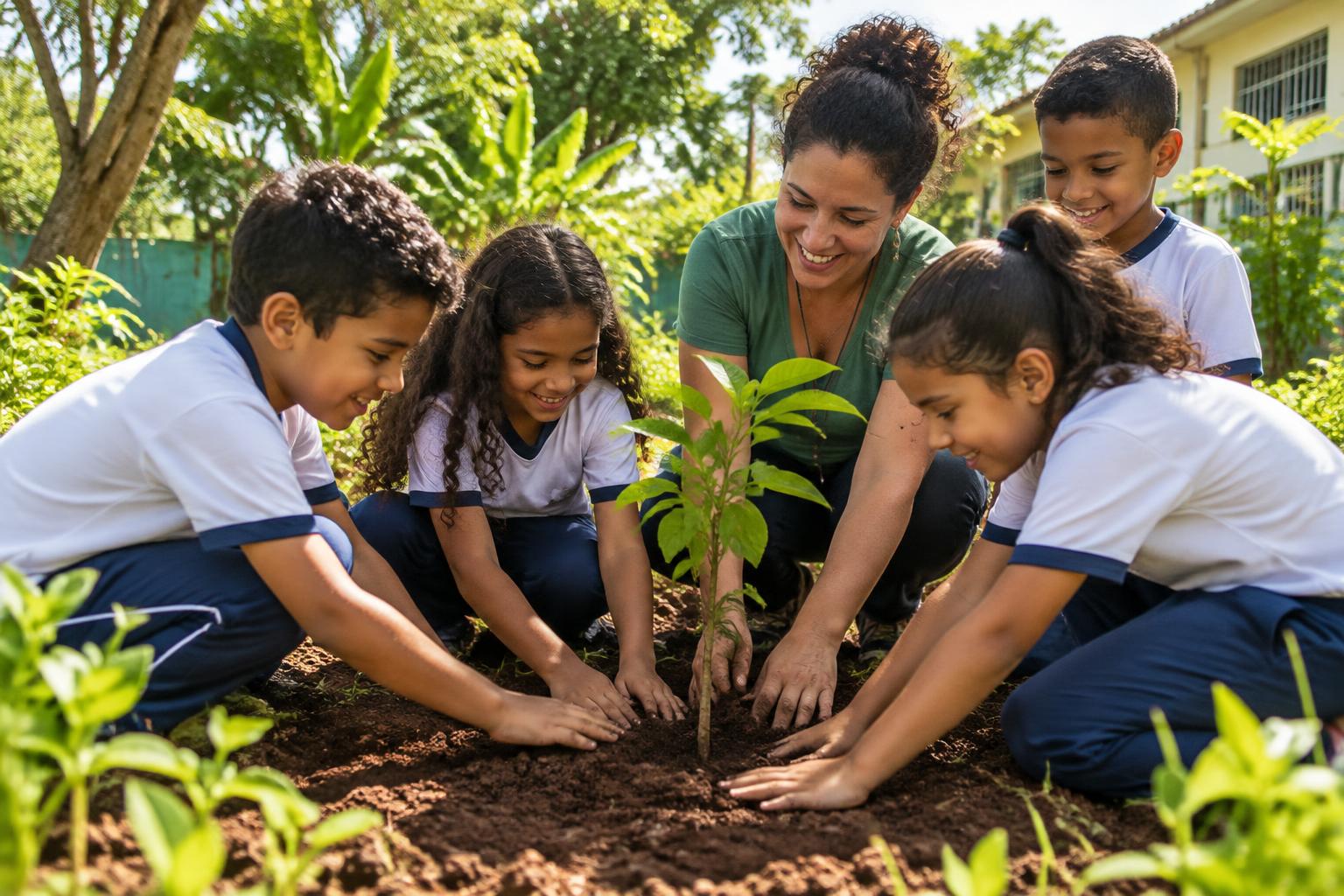
Climate Cooperative restores degraded land in Brazil with local farming families. A school forest is a set of agroforestry plots funded by your school, shown together on one public page with a map. Students, parents and teachers can see where the trees are and how the project develops.
One-off payment. You can add more plots or a monthly plan later.
About US$11, £8 or C$16. Charged in euros; your bank sets the exact amount.
How it works
1. You fund a plot
€10 funds one agroforestry plot: 5 fruit and native trees on one GPS location in Brazil. Paid once, no subscription.
2. Local families plant and care
Farming families in Brazil plant and look after the trees. The land produces food while it recovers.
3. You get your forest page and QR code
In your account you create your forest page in one step. You receive your own link and QR code.
4. Share it and follow it
Everyone who buys through your QR code joins your forest automatically. Their plots appear on your map with coordinates and field updates.
Impact figures are modeled: up to 3.5 t CO2 over 20 years and about 50 kg of food per year per plot of 5 trees. This is not a carbon offset and not an investment.

See a real example
This is the QR code of the LAHC school network. Scan it with your phone: it opens their forest page, where families choose their school. Your own code works the same way.
Where your QR code works best
- Parent newsletter and school app
- Poster at the entrance or in the classroom
- Event tables at open days and fairs
Why schools
A real place to learn from
Climate, biodiversity and food are easier to discuss when students can look at actual plots with coordinates, species and field updates.
Something the whole community can join
Parents, alumni and staff can add plots through the school's campaign link. Every contribution appears on the same map.
A contribution you can show
The school forest page is public and checkable. It shows what was funded, without large promises.
Why Brazil
Why we plant in the Amazon and the Atlantic Forest
It is usually the first question we get. We plant in Brazil because restoration there helps nature, the families who live there and the climate at the same time.
Two forests under pressure
Both are among the most species-rich forests on earth. Only about 12 percent of the original Atlantic Forest is still mature forest, and large parts of the Amazon in Para and Rondonia were cleared for pasture. Planting there reconnects fragments that wildlife needs.
Food and income for local families
Every plot is agroforestry: native trees mixed with fruit and food crops. Local farming families plant and care for the plots and keep the harvest, so a restored forest also means food and income where it grows.
Trees grow all year round
In the tropics there is no winter pause. Bananas in a young plot give shade in the first season and a first harvest after about a year. Acai and cacao follow after three to five years.
The climate is shared
CO2 mixes through the whole atmosphere, so a tree takes up carbon for everyone, wherever it stands. We model up to 3.5 t CO2 over 20 years per plot of five trees.
Linked to 9 of the 17 UN Sustainable Development Goals
Our projects are designed around these goals:
- 1No poverty
- 2Zero hunger
- 8Decent work and economic growth
- 9Industry, innovation and infrastructure
- 10Reduced inequalities
- 11Sustainable cities and communities
- 13Climate action
- 15Life on land
- 17Partnerships for the goals
Impact figures are modeled estimates. Funding a plot is not an offset and does not replace cutting your own emissions.
How schools use it in education
In lessons
Use the map and field updates in geography, biology or citizenship: where is the plot, what grows there, why mixed planting helps the soil.
Project week
Let a class run its own campaign with the school QR code and track the result on the map.
Milestones
Mark a graduation, a school anniversary or a sports day with one plot per class.
Parent evening
Put the A5 poster at the entrance so parents can add a plot to the school forest themselves.
Other countries and cultures
Partner schools in Brazil and Mexico each follow their own forest on this platform. Classes can learn about Brazil, the Amazon and the Atlantic Forest, and the farming families who plant the trees.
Student fundraiser
Students raise the money themselves, for example with a bake sale or a small market stall. It doubles as a business lesson: set a goal, price, promote and report the result on the map.
What you get
- Your own public forest page with a map of every plot
- A personal campaign link and QR code to share
- An A5 poster for your counter, classroom or window
- A certificate for each contribution
- Your name and logo on your forest page, if you want
- Field updates you can pass on to your customers or community
Example: LAHC schools
Schools in the LAHC network, including St. Nicholas School in Alphaville and Pinheiros (Brazil) and Victoria School in Mexico, each have their own school forest page, map, campaign links and posters.
See the LAHC school forestsStart with 1 plot
Try it first. Fund one plot of 5 trees, once. No subscription, no package, no commitment.
€10
1 plot, 5 trees, one GPS location
About US$11, £8 or C$16. Charged in euros; your bank sets the exact amount.
Start with 1 plot for €10When you want to do more
- A monthly plan, for example one plot per month
- Packages of 20, 60 or 200 plots, once or monthly, with an invoice
- A campaign where customers or parents add plots to your forest
Questions
What does it cost?
One plot of 5 trees costs €10. You decide how many plots and when.
What do students see?
A public school forest page with a map of each plot, the number of trees and field updates when they are available.
Where are the trees?
All plots are in Brazil, in agroforestry systems managed with local farming families.
Can parents take part?
Yes. They use the school's campaign link or QR code and their plots are added to the school forest.
Our budget is tight. Can we still join?
Yes. One plot costs €10 and the school does not need its own budget: students can raise it with a small fundraiser, or parents add plots through the school link.
Do we have to sign up for a monthly plan?
No. You can start with one plot, paid once. A monthly plan or a package is optional and can be added at any time.
Is this a carbon offset?
No. Funding plots is an additional contribution to restoration in Brazil. It does not cancel emissions, and we ask partners not to present it that way.
Talk to us
Questions, or want help setting up a campaign? Email us and we reply personally.
info@climate-cooperative.com